rccb wiring diagram
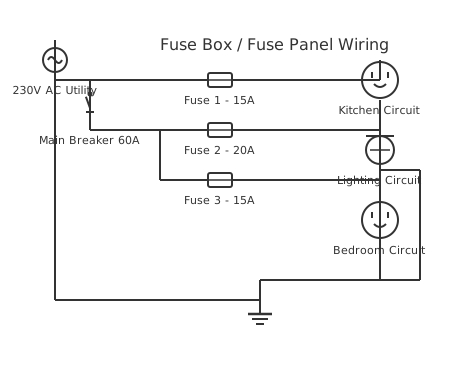
This is a free printable rccb wiring diagram: download the diagram as SVG or open it and print to paper or PDF.
Diagram checks and scope
- Components
- 9
- Wired connections
- 11
- Automated check
- Automated pin, route, source, and topology checks passed; this is not a safety certification.
A Rccb Wiring Diagram wiring diagram provides comprehensive guidance for electrical installation and troubleshooting in automotive and industrial applications. This specialized diagram illustrates the proper connections, wire gauges, component placement, and safety procedures required for correct system operation. Understanding this wiring is essential for technicians, electricians, and professionals working with electrical systems. The diagram shows all connections with color coding, amperage ratings, and grounding requirements to ensure safe and reliable operation. Proper installation following this diagram prevents electrical hazards, system failures, and compliance issues. The schematic includes detailed information about terminals, connections, and circuit protection measures. Professional implementation of this diagram ensures optimal system performance, equipment longevity, and electrical safety for all users and equipment.
How to wire rccb wiring diagram
- Select correct RCCB sensitivity for the application 30mA RCCBs are standard for general domestic and commercial circuits. 10mA for medical locations, swimming pools, and bathrooms. 100mA or 300mA for fire protection only — these do not provide shock protection.
- Isolate the main incomer before installation Switch off the main breaker or remove the utility fuse before wiring the RCCB. The supply-side terminals of the main incomer remain live until utility isolation — do not touch them.
- Mount the RCCB on the DIN rail correctly Snap the RCCB onto the DIN rail with the test button accessible and the terminal labels visible. Cramped mounting that hides the test button prevents mandatory monthly testing.
- Route neutral through the RCCB torroid correctly Both live and neutral must pass through the RCCB's internal toroidal transformer. Bypassing the neutral — running it externally — means the differential measurement is wrong and the RCCB cannot detect earth faults.
- Torque all terminals to manufacturer specification Under-torqued terminals cause resistance heating and eventual insulation damage. Typical torque is 2–3 Nm for 16–40A RCCBs — always check the datasheet, not the feel of the screwdriver.
- Verify no shared neutrals between RCCB circuits Each RCCB must protect a circuit where its own neutral returns through it. Shared neutrals between separate RCCB groups introduce phantom differential currents that cause nuisance tripping under load.
- Commission with test equipment, not guesswork Use an RCD tester (such as a Fluke or Megger loop/RCD tester) to measure actual trip time at 30mA, 150mA, and 5x rated current. Record results for the CoC (Certificate of Compliance) if issuing one.
Frequently asked questions
What happens if I connect the neutral through the RCCB incorrectly?
If any neutral conductor bypasses the RCCB core, the RCCB sees a permanent imbalance and either trips continuously or fails to trip on a genuine earth fault. Every conductor feeding circuits protected by the RCCB — both phase and neutral — must pass through it.
Can one RCCB protect multiple circuits?
Yes. In a typical domestic DB, one 25A or 40A RCCB covers multiple downstream MCBs. The RCCB provides earth leakage protection for all those circuits simultaneously. The downside is that an earth fault on any one circuit trips the RCCB and removes power from all protected circuits.
What is an RCBO and when should I use one instead of an RCCB?
An RCBO (residual current circuit breaker with overcurrent protection) combines an MCB and RCCB in a single device for one circuit. Use RCBOs when you need individual circuit earth leakage protection without a common trip affecting other circuits — common in commercial and medical installations.
Does an RCCB protect against fire caused by arcing faults?
No. Standard 30mA RCBOs and RCCBs detect current imbalance, not arcing. Arc fault detection devices (AFDDs) are required for arc fault protection. SANS 10142-1 has provisions for AFDDs in high-risk circuits, though they are not yet universally mandated in SA.
What size RCCB do I need for a geyser circuit?
A geyser circuit requires a 25A RCCB minimum per SANS 10142-1, with a 30mA trip threshold. The RCCB must be on the load side of the dedicated geyser MCB or combined as an RCBO. Undersizing the RCCB causes nuisance tripping under normal geyser element inrush.
Sources and verification
Review status: Not independently reviewed. Automated topology checks confirm stored terminals and routes, not the correctness of manufacturer pin assignments, ratings, regional codes, or installation decisions. Verify those claims against the current primary documentation before use.
- IEC 61082-1:2014 — Rules for electrotechnical documents — International Electrotechnical Commission. Supports: General diagram, drawing, table, and reference-designation presentation conventions. Checked 2026-07-15.