single pole light switch wiring diagram
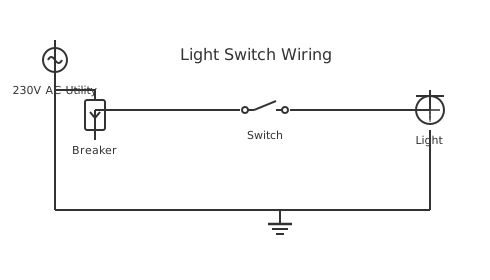
This is a free printable single pole light switch wiring diagram: download the diagram as SVG or open it and print to paper or PDF.
Diagram checks and scope
- Components
- 5
- Wired connections
- 5
- Automated check
- Automated pin, route, source, and topology checks passed; this is not a safety certification.
A single-pole light switch wiring diagram shows the fundamental residential lighting control circuit where one switch controls a light fixture from a single location. The diagram clearly illustrates the hot wire path through the switch that interrupts power to the fixture, the neutral wire that returns current without switch interruption, and the ground wire that provides emergency fault protection. Single-pole switches are the most common residential switch type, with brass-colored terminals for hot wire connections and silver-colored terminals for load circuits. The diagram demonstrates proper wire color usage: black or red for hot conductors, white for neutral returns, and green or bare copper for grounding. Understanding single-pole switch installation is fundamental for homeowners and electricians performing basic electrical work safely and code-compliantly. The diagram emphasizes that neutral and ground wires must not be interrupted by the switch, protecting against hazardous situations where fixtures remain energized during "off" conditions. Installation variations include switch-only boxes for mid-circuit locations and combination switch-outlet boxes for space efficiency.
How to wire single pole light switch wiring diagram
- Isolate at the distribution board Switch off the relevant lighting MCB. Use a non-contact tester to confirm the switch box cables are dead. Some homes have separate circuits feeding different parts of a room — test every cable you can see.
- Remove the old switch plate Unscrew the face plate screws. Pull the switch assembly forward carefully — cables are often short and the box shallow. Photograph the terminal connections before removing any wires.
- Remove wires from old switch terminals Loosen each terminal screw and withdraw the conductor. Note the conductor colours and positions. If sleeves are fitted on any conductors, preserve them and refit on the new switch.
- Connect live to the input terminal Connect the permanent live (or the conductor identified as live with your tester) to the line or input terminal of the new switch. This is the terminal that is live regardless of switch position.
- Connect switched live to the output terminal Connect the conductor going to the light fitting to the load or output terminal. Sleeve it brown if it is not already brown — a non-brown conductor in this position is a labelling obligation under SANS 10142-1.
- Fit earth and close up Connect earth to the metal box earth terminal and to the switch plate earth lug if the plate is metal. Fold cables carefully into the box — a sharp bend immediately behind a terminal can break the conductor. Screw the plate down evenly.
Frequently asked questions
What is a single pole light switch?
A single pole switch interrupts only one conductor — the live — in a single circuit. It has two terminals: one for incoming live and one for outgoing switched live. It controls one light or group of lights from one location only.
Is it safe to switch the neutral instead of the live?
No. Switching the neutral leaves the load and all wiring to it at live potential even when the switch is off — a serious shock hazard. Always interrupt the live conductor. This applies equally to single pole and double pole switching.
What size cable do I need for a light switch circuit?
1.5mm² twin and earth is standard for domestic lighting circuits in SA. The cable must be rated for the circuit MCB — typically 16A for lighting. 1.5mm² cable carries up to 15A, which is more than adequate for domestic lighting loads.
Can I replace a single pole switch with a double pole switch?
Yes, and in some applications it is better practice. A double pole switch interrupts both live and neutral, fully isolating the fitting — useful for bathroom lights, pool equipment, and anywhere you want full isolation without going to the DB.
Why does my new switch spark when I press it?
A small spark on a mechanical switch is normal — it is the arc that forms as the contacts make and break under load. Excessive or persistent sparking suggests the switch is undersized for the load, there is a capacitive load like a dimmer, or the contacts are worn.
Sources and verification
Review status: Not independently reviewed. Automated topology checks confirm stored terminals and routes, not the correctness of manufacturer pin assignments, ratings, regional codes, or installation decisions. Verify those claims against the current primary documentation before use.
- IEC 61082-1:2014 — Rules for electrotechnical documents — International Electrotechnical Commission. Supports: General diagram, drawing, table, and reference-designation presentation conventions. Checked 2026-07-15.
Related diagrams
- eaton single pole switch wiring diagram
- 3 way switch single pole wiring diagram
- double pole single throw switch diagram
- leviton single pole switch wiring diagram
- single light switch wiring diagram
- single pole dimmer switch wiring diagram