wiper motor wiring diagram
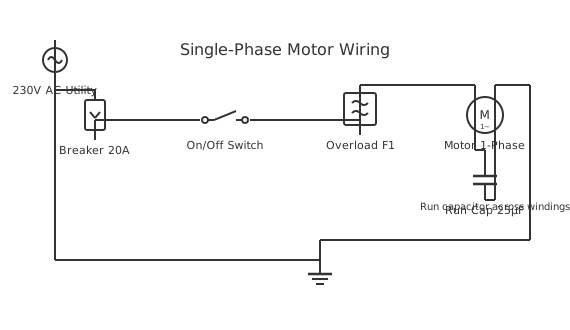
This is a free printable wiper motor wiring diagram: download the diagram as SVG or open it and print to paper or PDF.
Diagram checks and scope
- Components
- 7
- Wired connections
- 8
- Automated check
- Automated pin, route, source, and topology checks passed; this is not a safety certification.
A Wiper Motor Wiring Diagram wiring diagram provides comprehensive guidance for electrical installation and troubleshooting in automotive and industrial applications. This specialized diagram illustrates the proper connections, wire gauges, component placement, and safety procedures required for correct system operation. Understanding this wiring is essential for technicians, electricians, and professionals working with electrical systems. The diagram shows all connections with color coding, amperage ratings, and grounding requirements to ensure safe and reliable operation. Proper installation following this diagram prevents electrical hazards, system failures, and compliance issues. The schematic includes detailed information about terminals, connections, and circuit protection measures. Professional implementation of this diagram ensures optimal system performance, equipment longevity, and electrical safety for all users and equipment.
How to wire wiper motor wiring diagram
- Disconnect battery negative before accessing the motor The wiper motor circuit draws 3–8A and the park switch stays live in some positions. Disconnect battery negative to prevent the motor firing unexpectedly while hands are near the mechanism.
- Identify the multi-pin wiper motor connector Most vehicle wiper motors use a 3–6 pin connector: permanent 12V supply, earth, low-speed, high-speed, and park switch return. Confirm pin assignments from the vehicle-specific wiring diagram — they vary significantly between manufacturers.
- Trace and test the park switch function The park switch is a normally-closed internal switch that keeps the motor running until the wipers reach the rest position. A fault here causes wipers that stop randomly mid-sweep — test resistance between park switch pins to confirm operation.
- Verify earth connection at the motor body Wiper motors earth through the motor body mounting bolts to the firewall. Remove bolts, clean paint from the contact surfaces, apply anti-corrosion grease, and refit. High-resistance earths cause slow wipers that fail to park correctly.
- Test low-speed and high-speed operation separately Apply 12V to the low-speed terminal and confirm motor runs at reduced speed. Then apply 12V to the high-speed terminal. On the bench, high speed should be clearly faster. Both speeds using the same terminal indicates incorrect wiring.
- Confirm relay operation if fitted Many vehicles use a wiper relay in the fuse box. Swap the relay with an identical spare to test — a stuck-closed relay causes wipers that run continuously regardless of the stalk position.
- Check linkage and pivot condition before reassembly A correctly wired motor that moves slowly or struggles is usually a worn pivot bush, not an electrical fault. Dry pivots increase motor current draw significantly and can trip the thermal overload inside the motor.
Frequently asked questions
How many wires does a wiper motor typically have?
Most two-speed wiper motors have five wires: permanent earth (brown or black), slow speed (feed from slow relay), fast speed (feed from fast relay), park feed (permanent 12V to enable park function), and park switch output (the self-parking circuit that returns wipers to the park position).
Why do my wipers not park correctly after fitting a replacement motor?
The park mechanism relies on a permanent 12V feed to the park input terminal, separate from the wiper switch. If this wire is not connected, the motor loses power the moment the switch is turned off and stops mid-screen. Check the wiring diagram for your specific motor — park terminal designation varies between manufacturers.
What fuse protects the wiper motor circuit?
The wiper motor circuit fuse is typically 15–20 amps, located in the main fuse box. The wiper motor draws around 3–5 amps running but can draw 10–15 amps if the blades are stiff or the screen is iced. A seized wiper linkage will blow this fuse within seconds.
Can I run front and rear wipers from the same motor?
No. Front and rear wipers are separate motors, operated independently. The rear wiper motor is much smaller and is mounted in the tailgate. They share the same fuse box but have separate relays, fuses, and switch circuits.
What causes the wiper motor to run but the blades not move?
The wiper linkage or transmission has separated from the motor spindle. This is a mechanical failure, not electrical. On most vehicles, the linkage clips onto the motor spindle with a plastic clip that fatigues over time. The motor runs at full speed with no load — not a good sign for the motor's longevity.
Sources and verification
Review status: Not independently reviewed. Automated topology checks confirm stored terminals and routes, not the correctness of manufacturer pin assignments, ratings, regional codes, or installation decisions. Verify those claims against the current primary documentation before use.
- IEC 61082-1:2014 — Rules for electrotechnical documents — International Electrotechnical Commission. Supports: General diagram, drawing, table, and reference-designation presentation conventions. Checked 2026-07-15.
Related diagrams
- 3 wire wiper motor wiring diagram
- 4 wire wiper motor wiring diagram
- 5 wire wiper motor wiring diagram
- 4 wire stepper motor wiring diagram
- servo motor circuit diagram
- servo motor pin diagram