two way wiring diagram
This is a free printable two way wiring diagram: download the diagram as SVG or open it and print to paper or PDF.
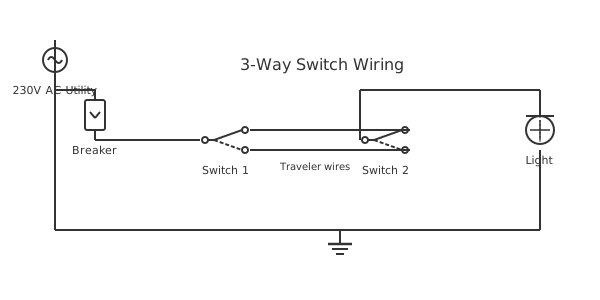
A two-way wiring diagram shows how two switches control a single light from different locations, essential for residential lighting design. Two-way switching employs two three-way switches connected by intermediate wires, allowing light activation from either location independently. The diagram illustrates fundamental circuit topology with proper color coding.
How to wire two way wiring diagram
- Switch off the circuit breaker Isolate the lighting circuit at the DB board and verify dead with a voltage tester at the switch positions before removing any switch plates.
- Run 3-core cable between the two switch positions Install 1.5 mm² 3-core plus earth cable in conduit or surface-mounted trunking between switch box 1 and switch box 2. Follow SANS 10142-1 wiring routes.
- Connect the supply at switch 1 The incoming active (phase) conductor connects to the common terminal (COM) of switch 1. Neutral bypasses both switches and goes directly to the light fitting.
- Connect the traveller wires between the switches Connect the two traveller conductors from the 3-core cable to the two L1 and L2 terminals on switch 1. Connect the other ends to L1 and L2 on switch 2.
- Connect the switched live at switch 2 The common terminal (COM) of switch 2 becomes the switched live output. Connect this conductor to the active terminal at the light fitting.
- Connect earths Connect all earth conductors to the earth terminals in both switch boxes. Metal switch plates must be earthed. Light fittings with metal parts must also be earthed.
- Test both switch positions Reinstate the circuit breaker and test that the light operates correctly from both switch positions — on and off from each independently.
Frequently asked questions
What is a two-way switch and where is it used?
A two-way switch allows a light to be controlled from two separate locations — the top and bottom of a staircase, or each end of a corridor. Two switches are wired with a common wire and two traveller wires between them, sharing control of one circuit.
How many wires do I need for a two-way switching circuit?
You need a 3-core cable (plus earth) between the two switches — one common and two traveller conductors. The supply enters the first switch and the switched live exits to the lamp from either switch (depending on wiring method).
What is the 'common' terminal on a two-way switch?
The common terminal is the single terminal that connects to either traveller depending on the switch position. It is usually a different colour (often black or marked 'COM') on the terminal block. Getting this wrong causes the light to only work from one position.
Can I add a third switching point to an existing two-way circuit?
Yes — add an intermediate switch (also called a cross-over switch) between the two existing two-way switches. The intermediate switch crosses or straight-wires the two travellers depending on its position, enabling control from three or more locations.
What cable should I use for two-way switching in domestic installations in SA?
Use 1.5 mm² 3-core plus earth PVC cable for standard domestic lighting circuits per SANS 10142-1. The earth conductor must be present and connected to the switch earth terminal if the switch has a metal faceplate.
Related diagrams
- two way lighting circuit
- two way switch circuit
- two way switch wiring
- wiring two way light switch
- 1 gang 1 way switch wiring diagram
- 1 gang 2 way switch wiring diagram