PLC Input Module Symbol
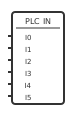
Definition: The PLC Input Module symbol represents a digital input interface module of a Programmable Logic Controller, designated DI in schematics, that accepts discrete ON/OFF voltage signals from field devices (sensors, switches, push-buttons) through six input terminals I0–I5 and converts them to logic states for the CPU program, per IEC 61131-2 and IEC 61131-3.
Also known as: digital input module, DI module, PLC input card, discrete input module, digital input interface, PLC I/O input module.
What the PLC Input Module symbol means
The PLC Input Module symbol denotes the hardware interface between field-level sensors and switches and the PLC CPU's program. Each input channel (I0 through I5) connects to a field device output (sensor, limit switch, push-button, relay contact) and reads its ON or OFF state. The module optically isolates the field signals from the CPU logic circuits for noise immunity and electrical protection.
In control system wiring diagrams, the PLC Input Module symbol appears in the input section of PLC panels, with field device wires terminating at the I0–I5 terminals. The module converts field voltages (24 V DC, 120 V AC, or 230 V AC depending on module type) into the low-voltage logic signals the CPU scans on each program cycle.
How to identify the PLC Input Module symbol
The PLC Input Module symbol is drawn as a rectangle labelled 'PLC Input', 'DI Module', or 'Digital Input Module'. Six input terminals labelled I0, I1, I2, I3, I4, and I5 are shown on the field-wiring side (typically the left or top), representing the discrete input channels. A connection or bus symbol may appear on the other side representing the backplane connection to the PLC CPU. Some representations show the common terminal (COM or 0 V) and a 24 V supply terminal alongside the input terminals.
Function and usage boundary
Each channel of a PLC Input Module contains an optocoupler (optical isolator) circuit that converts the field-side signal voltage into an isolated logic-level signal for the CPU. When the field voltage at an input terminal (e.g., I0) exceeds the ON threshold (typically 15–30 V DC for a 24 V module), the optocoupler activates and the channel reads as logical 1 (ON). Below the OFF threshold (typically 0–5 V DC), the channel reads as logical 0 (OFF). Optical isolation prevents field-side transients and ground faults from damaging the CPU electronics. A common (COM) terminal or supply return completes each input circuit.
Standards: IEC vs ANSI
| IEC 60617 | IEC 61131-2 (Programmable Controllers — Equipment Requirements and Tests) specifies the electrical characteristics of PLC input modules: input voltage ranges, threshold levels, optical isolation requirements, and noise immunity. IEC 61131-3 defines how input states (I0–I5) are addressed in PLC programs. IEC 60947-5-2 is relevant for the field sensors that connect to the input terminals. |
|---|---|
| ANSI/IEEE 315 | ANSI/NEMA ICS 1 and ICS 2 cover programmable controllers and their I/O modules. UL 508A governs industrial control panel wiring including PLC input module wiring. NFPA 79 specifies how field devices connect to PLC inputs in machine electrical systems. |
| Key difference | No distinct IEC vs ANSI schematic symbol difference exists for the PLC Input Module; both use a labelled rectangle with numbered input terminals. IEC 61131-2 is the universally adopted technical standard for PLC hardware internationally and in North America. |
The displayed SVG is the live editor implementation, not a licensed reproduction or certification of an IEC or IEEE database glyph. Verify the exact official entry and project edition before issuing work.
Logical terminals
| Logical ID | Editor terminal name |
|---|---|
| i0 | I0 |
| i1 | I1 |
| i2 | I2 |
| i3 | I3 |
| i4 | I4 |
| i5 | I5 |
Where the PLC Input Module symbol is used
- Machine panel wiring: limit switches, proximity sensors, and push-buttons connect to PLC Input Module channels to provide position, presence, and operator-command signals
- Process plant instrumentation: 24 V DC discrete signals from flow switches, level switches, pressure switches, and temperature switches connect to DI modules
- Conveyor and material handling: photoelectric sensors, inductive sensors, and reed switches connect to input module channels for object detection and position sensing
- Safety circuit monitoring: safety relay output contacts and safety door switch outputs feed into PLC DI channels for software safety monitoring (complementary to hardwired safety circuits)
- Motor control feedback: auxiliary contacts from contactors and motor protection relays connect to input channels to confirm motor run/stop and fault states
- Building automation: digital signals from occupancy sensors, door contacts, and lighting relay status connect to BAS controller input modules
Key facts
- The PLC Input Module symbol (designator DI) represents a discrete input interface with six input channels labelled I0 through I5 that read ON/OFF signals from field devices.
- IEC 61131-2 defines the electrical specifications for PLC input modules, including ON/OFF threshold voltages, input current, isolation requirements, and response times.
- Each input channel contains an optocoupler for electrical isolation between the high-voltage field wiring and the low-voltage PLC CPU logic circuits.
- The most common industrial input voltage standard is 24 V DC (IEC Type 1 and Type 3); modules are also available for 120 V AC and 240 V AC field signals.
- Input terminal numbering follows IEC 61131 convention: I0, I1, I2, I3, I4, I5 for the first module, extending to I0.0–I0.7 in byte-addressed larger systems.
- PLC input modules provide fast response times (0.1–5 ms), enabling detection of short-duration pulses and high-speed counting in some module variants.
- Field devices connected to PLC inputs must be compatible with the module's input voltage type (sinking/NPN or sourcing/PNP wiring) — mismatch prevents correct signal reading.
- In IEC 61131-3 program notation, input bits are addressed as I (or %I in symbolic addressing): e.g., %I0.0 for the first input of the first module.
Diagrams that use this symbol
- xnx xnx transmitter wiring diagram
- plc diagram
- 1756 of8 wiring diagram
- 1756 if16 wiring diagram
- plc panel wiring diagram
- plc circuit diagram
- plc schematic
- 1756 ib16 wiring diagram
Frequently asked questions
What does the PLC input module symbol mean in a wiring diagram?
The PLC Input Module symbol (designator DI) in a wiring diagram means that field devices (sensors, switches, push-buttons) connect their digital ON/OFF signals to the numbered input channels (I0–I5) of this module, which passes the states to the PLC CPU's program scan. Each high voltage at an input channel is read as logical 1 (ON) by the program.
What does the PLC input module symbol look like?
The PLC Input Module symbol is a labelled rectangle with six input terminals labelled I0, I1, I2, I3, I4, and I5 on the field-wiring side. The label 'PLC Input', 'DI Module', or 'Digital Input' appears inside the rectangle. A backplane bus connection symbol on the opposite side represents the interface to the PLC CPU.
What are the terminals (pins) on a PLC input module?
A PLC Input Module has six input channel terminals labelled I0, I1, I2, I3, I4, and I5, plus a COM (common/return) terminal that completes each input circuit. A 24 V supply terminal may be present if the module powers the field devices. Actual production modules may have 8, 16, or 32 input channels; the six-channel symbol is a representative schematic block.
What voltage signals does a PLC input module accept?
The most common PLC Input Module accepts 24 V DC discrete signals (IEC 61131-2 Type 1 or Type 3), switching between 0 V (OFF) and +24 V (ON). The ON threshold is ≥15 V DC and the OFF threshold is ≤5 V DC. Modules are also available for 120 V AC or 240 V AC field signals, as well as 5 V TTL logic for encoder or proximity sensor inputs.
What is the difference between sinking (NPN) and sourcing (PNP) wiring for PLC inputs?
A sinking (NPN) input module requires the field device to sink (pull down) the input terminal to 0 V when active; the common terminal connects to +24 V. A sourcing (PNP) input module requires the field device to source (provide) +24 V to the input terminal when active; the common connects to 0 V. NPN sensors are used with sourcing inputs and PNP sensors with sinking inputs (or vice versa for active-low configurations — check the module datasheet).
What standard defines PLC input module specifications?
IEC 61131-2 (Programmable Controllers — Equipment Requirements and Tests) specifies the electrical characteristics of PLC input modules including voltage ranges, threshold levels, isolation, and response times. In North America, UL 508A governs industrial control panel construction including PLC I/O module wiring. IEC 61131-3 defines how input addresses (I0, I1, etc.) are used in the control program.
How does a PLC input module protect the CPU from field-side faults?
Each input channel incorporates an optocoupler (optical isolator) that uses a light path to transfer the signal between the field-side circuit and the CPU-side logic, providing galvanic isolation typically rated at 500–1500 V. This means a field-side voltage spike, short circuit, or ground fault cannot damage the CPU. Input modules also typically include transient protection (TVS diodes) and RC filters to suppress electrical noise.
Related symbols
- ADC Block symbol
- Rotary Encoder Module symbol
- 4x4 Matrix Keypad symbol
- Microphone symbol
- PLC CPU symbol
- PLC Output Module symbol
Physical components that use this symbol
A schematic symbol defines electrical intent; the physical profile adds package or panel dimensions and mounting data.
Place the PLC Input Module symbol directly on a wiring diagram or schematic in the free online editor — no download required.