PLC Output Module Symbol
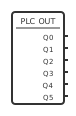
Definition: The PLC Output Module symbol represents a digital output interface module of a Programmable Logic Controller, designated DO in schematics, that receives commanded ON/OFF states from the CPU program and switches power to field actuators (motors, solenoids, indicators) through six output terminals Q0–Q5, per IEC 61131-2 and IEC 61131-3.
Also known as: digital output module, DO module, PLC output card, discrete output module, digital output interface, PLC I/O output module.
What the PLC Output Module symbol means
The PLC Output Module symbol denotes the hardware interface between the PLC CPU's program and field-level actuators, drives, and indicators. Each output channel (Q0 through Q5) is switched ON or OFF by the CPU program, delivering the control voltage or switching contact needed to energise a solenoid valve, motor starter coil, indicator light, or drive enable signal.
In control system wiring diagrams, the PLC Output Module symbol appears in the output section of PLC panels, with actuator load wires terminating at the Q0–Q5 terminals. Output modules are available in relay, transistor (DC), or triac (AC) output types, each suited to different field device voltage levels and switching speeds.
How to identify the PLC Output Module symbol
The PLC Output Module symbol is drawn as a rectangle labelled 'PLC Output', 'DO Module', or 'Digital Output Module'. Six output terminals labelled Q0, Q1, Q2, Q3, Q4, and Q5 are shown on the field-wiring side (typically the right or bottom), representing the discrete output channels. A backplane connection symbol on the other side represents the interface to the PLC CPU. Some representations also show a common (COM) or supply terminal alongside the output terminals.
Function and usage boundary
Each channel of a PLC Output Module switches power to the connected field actuator based on the state commanded by the CPU program. Relay output modules contain a miniature electromechanical relay per channel — contacts switch up to 250 V AC or 30 V DC at 0.5–2 A. Transistor (solid-state) output modules use a power transistor or MOSFET to switch 24 V DC loads with fast response (< 0.1 ms) but lower voltage tolerance. Triac output modules switch AC loads (typically 120/240 V AC) using triacs, offering solid-state switching for AC solenoids and contactors. Optical isolation separates field-side wiring from CPU logic in all module types.
Standards: IEC vs ANSI
| IEC 60617 | IEC 61131-2 specifies the electrical characteristics of PLC output modules: output types (relay, transistor, triac), voltage and current ratings, isolation requirements, and load types. IEC 61131-3 defines how output states are addressed in programs (Q0, Q1, or %Q0.0 in symbolic notation). IEC 60947-4-1 is relevant for the motor starters and contactors driven by PLC outputs. |
|---|---|
| ANSI/IEEE 315 | ANSI/NEMA ICS 1 and ICS 2 cover programmable controllers including output modules. UL 508A governs industrial control panel wiring and specifies output module wiring requirements. NFPA 79 specifies actuator wiring from PLC output modules in machine electrical systems. |
| Key difference | No distinct IEC vs ANSI symbol difference exists for the PLC Output Module; both use a labelled rectangle with numbered output terminals. IEC 61131-2 is the globally adopted technical standard for PLC output module specifications. |
The displayed SVG is the live editor implementation, not a licensed reproduction or certification of an IEC or IEEE database glyph. Verify the exact official entry and project edition before issuing work.
Logical terminals
| Logical ID | Editor terminal name |
|---|---|
| q0 | Q0 |
| q1 | Q1 |
| q2 | Q2 |
| q3 | Q3 |
| q4 | Q4 |
| q5 | Q5 |
Where the PLC Output Module symbol is used
- Motor control: PLC output channels (Q0, Q1) drive contactor coils for motor start/stop, with each output channel connected in series with control power and the contactor coil
- Solenoid valve control: Q channels energise pneumatic and hydraulic solenoid valve coils (24 V DC or 120/240 V AC) to control actuators and cylinders
- Pilot light and indicator control: output channels drive 24 V DC LED pilot lights on panel fronts to provide operator status feedback
- Drive enable and reference: Q channel output enables variable frequency drives (VFDs) and servo drives, triggering run commands
- Conveyor and packaging machines: output channels control multiple conveyor zones, pneumatic cylinders, and diverters via relay and transistor outputs
- Building automation: output channels control HVAC damper actuators, fan contactors, lighting relay coils, and access control lock releases
Key facts
- The PLC Output Module symbol (designator DO) represents a discrete output interface with six output channels labelled Q0 through Q5 that switch power to field actuators.
- IEC 61131-2 defines output module electrical specifications: relay, transistor (DC), and triac (AC) output types, each with rated voltage, current, and isolation requirements.
- Relay output modules switch up to 250 V AC / 30 V DC at 0.5–2 A per channel and provide complete galvanic isolation but have limited switching speed (5–20 ms) and mechanical life.
- Transistor output modules switch 24 V DC loads with sub-millisecond response time (< 0.1 ms), making them suitable for high-speed applications and PWM output, but limited to 24 V DC.
- Triac output modules switch AC mains loads (120/240 V AC) using solid-state triacs, providing silent, spark-free switching with faster operation than relay outputs for AC solenoids and contactors.
- Output terminal numbering follows IEC 61131 convention: Q0, Q1, Q2, Q3, Q4, Q5 for the first module; in byte-addressed larger systems %Q0.0–%Q0.7.
- Each output channel is optically isolated from the CPU logic circuits, protecting the processor from load-side transients, short circuits, and inductive voltage spikes.
- In IEC 61131-3 program notation, output bits are addressed as Q (or %Q in symbolic addressing): e.g., %Q0.0 for the first output of the first module; when the program sets %Q0.0 = 1, the physical channel Q0 energises.
Diagrams that use this symbol
- plc diagram
- 1756 of8 wiring diagram
- 1756 if16 wiring diagram
- plc panel wiring diagram
- plc circuit diagram
- plc schematic
- 1756 ib16 wiring diagram
- 1756 ow16i wiring diagram
Frequently asked questions
What does the PLC output module symbol mean in a wiring diagram?
The PLC Output Module symbol (designator DO) in a wiring diagram means that field actuators (motor starters, solenoid valves, indicator lights) connect their power circuits to the numbered output channels (Q0–Q5) of this module. The PLC CPU program commands each channel ON or OFF on every scan cycle, switching power to the connected actuator.
What does the PLC output module symbol look like?
The PLC Output Module symbol is a labelled rectangle with six output terminals labelled Q0, Q1, Q2, Q3, Q4, and Q5 on the field-wiring side. The label 'PLC Output', 'DO Module', or 'Digital Output' appears inside the rectangle. A backplane bus connection symbol on the opposite side represents the interface to the PLC CPU.
What are the terminals (pins) on a PLC output module?
A PLC Output Module has six output channel terminals labelled Q0, Q1, Q2, Q3, Q4, and Q5, plus a COM (common) terminal that provides the return path for output currents, and a supply terminal (L+ for DC, L1/N for AC modules) that provides the switched power. Production modules may have 8, 16, or 32 output channels; the six-channel symbol is a representative schematic block.
What is the difference between relay, transistor, and triac PLC output modules?
Relay output modules contain electromechanical relays and can switch both AC and DC loads at up to 250 V AC / 30 V DC; they are the most versatile but slowest (5–20 ms switching) with limited relay life. Transistor output modules switch only 24 V DC loads using power transistors or MOSFETs, offering fast switching (< 0.1 ms) and unlimited electrical life. Triac output modules switch AC loads (120/240 V AC) using solid-state triacs, providing silent AC switching without the mechanical wear of relay contacts.
What standard defines PLC output module specifications?
IEC 61131-2 (Programmable Controllers — Equipment Requirements and Tests) specifies the electrical and performance requirements for PLC output modules including output types, voltage and current ratings, isolation voltage, and load types. UL 508A governs industrial control panel construction including PLC output module wiring in North America. IEC 61131-3 defines output addressing notation (Q0, Q1, %Q0.0, etc.) in control programs.
How does a PLC output module protect the CPU from load-side faults?
Each output channel uses an optocoupler (optical isolator) between the CPU logic side and the field load side, providing galvanic isolation typically rated at 1500–2500 V. For inductive loads (contactor coils, solenoid valves), a suppression circuit (RC snubber, freewheeling diode for DC, or MOV for AC) should be fitted across the load to absorb inductive kick voltages when the output switches off, protecting the module's output device from overvoltage.
How are PLC output channels addressed in the program?
In IEC 61131-3 notation, output bits are addressed as %Q followed by the byte and bit position: %Q0.0 for the first output of the first module (equivalent to Q0 in symbolic notation), %Q0.1 for the second channel (Q1), and so on. In Siemens TIA Portal, outputs are addressed as Q0.0–Q0.5 for the first module byte. Setting the output coil instruction to TRUE (1) in the ladder program closes the physical output channel and energises the connected actuator.
Related symbols
- DAC Block symbol
- Optocoupler Module symbol
- PLC CPU symbol
- PLC Input Module symbol
- Relay Module symbol
- Speaker symbol
Physical components that use this symbol
A schematic symbol defines electrical intent; the physical profile adds package or panel dimensions and mounting data.
Place the PLC Output Module symbol directly on a wiring diagram or schematic in the free online editor — no download required.