emergency light wiring diagram
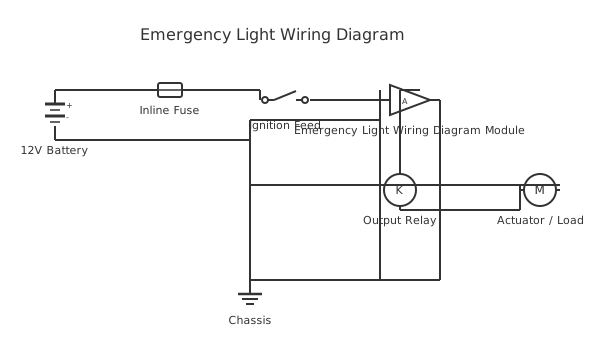
This is a free printable emergency light wiring diagram: download the diagram as SVG or open it and print to paper or PDF.
Diagram checks and scope
- Components
- 7
- Wired connections
- 10
- Automated check
- Automated pin, route, source, and topology checks passed; this is not a safety certification.
Emergency light wiring diagrams depict safety lighting systems that activate during power failures, using battery backup power to illuminate escape routes and critical areas. These diagrams show dual-source circuits that switch automatically from main AC power to backup batteries when necessary. The system typically includes a charging circuit that keeps batteries ready, a switching mechanism that detects power loss, and multiple light fixtures connected in series or parallel configurations. Battery backup ensures continuous illumination for at least 90 minutes, meeting building codes and safety regulations. The diagram illustrates how emergency lights differ from standard lighting by incorporating automatic transfer switches and dedicated battery units. Understanding these systems is crucial for building managers, electricians, and property owners who must ensure compliance with fire safety codes. Proper installation requires careful attention to circuit load calculations and backup power capacity to guarantee all emergency lights function reliably during actual emergencies.
How to wire emergency light wiring diagram
- Determine maintained vs non-maintained requirement Consult the building's fire certificate and SANS 10400-T evacuation plan before selecting fitting type. Installing non-maintained fittings where maintained are specified fails the fire compliance inspection.
- Plan the circuit — permanent live essential Emergency lights must connect to a permanent live feed — never to a switched circuit. If the lights only come on when the switch is on, they cannot charge and will not operate during a mains failure at night.
- Run the supply cable Typically 1.5mm² twin and earth is sufficient for LED emergency fittings. For long cable runs exceeding 30 metres, verify voltage drop does not affect the charging circuit.
- Connect permanent live and neutral At the fitting, connect permanent live (brown), neutral (blue), and earth (green/yellow) to the designated terminals. Do not connect to the switched live input unless you want maintained operation.
- Test the mains charging function Restore supply and confirm the charging indicator illuminates. Allow the battery to charge for 24 hours before performing a discharge test — testing a flat battery immediately after installation gives misleading results.
- Perform the function test Press the test button to simulate mains failure. The lamp must switch on immediately and maintain illumination. Record the date, result, and fitting location in the maintenance register.
- Label and log Fit a test label to the fitting recording the installation date and battery replacement schedule. Without records you cannot demonstrate compliance to a fire inspector or insurer.
Frequently asked questions
How does an emergency light know when to switch on?
The emergency light monitors the mains supply continuously. When it detects mains failure, an internal inverter circuit switches the lamp onto the built-in battery within half a second. No external signal or control wiring is needed for basic maintained or non-maintained units.
What is the difference between maintained and non-maintained emergency lights?
A maintained fitting is lit during normal operation and remains lit on battery when mains fails — used in cinemas and entertainment venues. Non-maintained only illuminates on mains failure — standard for most commercial and industrial SA installations.
How long must an emergency light run on battery?
SANS 10400-T requires emergency lighting to provide a minimum of 1 hour of illumination after mains failure in South Africa. Many commercial installations specify 3 hours. Always verify the fitting's rated duration meets your building's compliance requirement.
What maintenance do emergency lights need?
Monthly: press the test button and confirm the light operates. Annually: perform a full discharge test — isolate mains and confirm the light runs for its full rated duration. Log all tests. Batteries typically need replacement every 3-4 years.
Why is my emergency light permanently illuminated even with mains present?
Either the fitting is a maintained type wired as permanent, the mains detection circuit has failed, or the input wiring is incorrect. Check that the mains live feed is connected to the correct terminal — emergency lights have separate terminals for permanent live and switched live.
Sources and verification
Review status: Not independently reviewed. Automated topology checks confirm stored terminals and routes, not the correctness of manufacturer pin assignments, ratings, regional codes, or installation decisions. Verify those claims against the current primary documentation before use.
- IEC 61082-1:2014 — Rules for electrotechnical documents — International Electrotechnical Commission. Supports: General diagram, drawing, table, and reference-designation presentation conventions. Checked 2026-07-15.
Full written guides
Related diagrams
- 4v rechargeable emergency light circuit diagram
- emergency light circuit diagram
- rechargeable emergency light circuit diagram
- 3 wire motion sensor light wiring diagram
- eaton light switch wiring diagram
- light sensor circuit diagram