How to Wire a Line Output Converter to Your Vehicle System
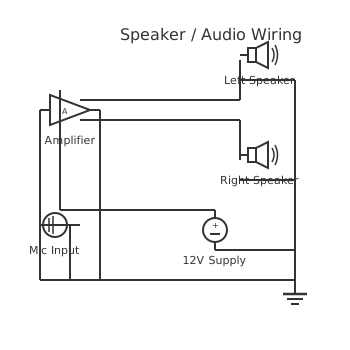
This is a free printable line out converter wiring diagram: download the diagram as SVG or open it and print to paper or PDF.
Line output converters (LOC) are essential interface devices that extract speaker-level signals from factory amplifiers and convert them to RCA line-level outputs for aftermarket audio equipment installation.
Diagram checks and scope
- Components
- 6
- Wired connections
- 11
- Automated check
- Automated pin, route, source, and topology checks passed; this is not a safety certification.
Line output converters serve as critical bridge components in automotive audio upgrades, converting high-voltage speaker signals into low-voltage RCA outputs compatible with aftermarket amplifiers and processors. Factory head units typically output through speaker terminals at 4-40V, while aftermarket equipment requires line-level signals of 200mV to 2V for proper operation. The LOC receives these speaker signals, performs voltage reduction and impedance conversion, and outputs balanced RCA connections for clean signal transfer without distortion. Internal circuitry includes transformers, resistor networks, and sometimes active amplification stages designed for specific vehicle platforms and output impedances. Proper installation requires connecting LOC inputs to factory amplifier outputs, grounding the device to the vehicle chassis through a dedicated ground wire, and routing RCA cables to the aftermarket unit while maintaining physical isolation from power cables to prevent electromagnetic interference and noise pickup. Ground loops must be eliminated through careful grounding at a single point near the audio installation location using proper crimped connections. The converter enables seamless integration without cutting factory wiring, preserving factory features like steering wheel controls while expanding system capabilities with subwoofers, external amplifiers, and advanced digital processing systems for enhanced audio quality. Signal integrity depends on proper shielding and grounding practices that prevent noise contamination of audio signals from engine ignition systems. Many audiophiles prefer LOC solutions over cutting factory harnesses because they maintain vehicle warranty compliance and complete reversibility without permanent modifications. Understanding the impedance matching between factory speaker outputs and aftermarket components ensures optimal signal transfer without distortion or signal loss during operation. Ground lug connections should be made to bare metal surfaces scraped clean of paint and corrosion to provide low-resistance electrical contact. Professional installers often run dedicated power grounds separate from signal grounds to minimize noise coupling between circuits. Twisted pair RCA cables with proper shielding provide better rejection of electromagnetic interference from engine systems and alternators. Quality connectors prevent corrosion issues that degrade signal quality over time in vehicles.
How to wire line out converter wiring diagram
- Locate factory amplifier outputs or speaker signal sources in your vehicle using the service manual
- Connect LOC input terminals to factory amplifier speaker output terminals using appropriate gauge wire
- Connect LOC ground terminal to vehicle chassis through a dedicated ground wire for noise-free operation
- Connect RCA output cables from LOC to your aftermarket amplifier inputs with proper shielding
- Test audio system for proper signal flow and verify ground connections are noise-free
Frequently asked questions
What is the difference between RCA and speaker level signals?
Speaker-level signals are 20-40V high-impedance outputs from amplifiers. RCA line-level is 200mV-2V low-impedance. LOC converters bridge this gap safely.
Where do I connect the LOC inputs?
Connect inputs to the factory amplifier speaker outputs, typically found behind the headrest, under seats, or in trunk. Consult your vehicle service manual for exact locations.
How should I ground the converter?
Ground to the vehicle chassis through a short, thick gauge wire connected to a clean, unpainted metal surface near the audio equipment location to eliminate noise.
Can I use regular RCA cables or do I need shielded cable?
Shielded, twisted RCA cables minimize noise pickup. Route them away from power cables and engine harnesses by at least 6 inches for optimal performance.
Will using a LOC affect factory system quality?
No, the converter preserves factory system operation while enabling integration of aftermarket components without modifications to factory wiring infrastructure.
Sources and verification
Review status: Not independently reviewed. Automated topology checks confirm stored terminals and routes, not the correctness of manufacturer pin assignments, ratings, regional codes, or installation decisions. Verify those claims against the current primary documentation before use.
- IEC 61082-1:2014 — Rules for electrotechnical documents — International Electrotechnical Commission. Supports: General diagram, drawing, table, and reference-designation presentation conventions. Checked 2026-07-15.
Related diagrams
- 2 channel line output converter wiring diagram
- axxess integrate output line converter
- line output converter installation diagram
- metra 2 channel line output converter diagram
- metra line output converter diagram
- phone line wiring diagram