power window wiring diagram
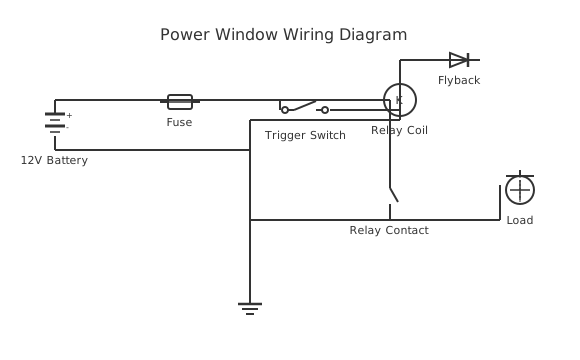
This is a free printable power window wiring diagram: download the diagram as SVG or open it and print to paper or PDF.
Diagram checks and scope
- Components
- 8
- Wired connections
- 10
- Automated check
- Automated pin, route, source, and topology checks passed; this is not a safety certification.
A power window wiring diagram shows the electrical circuits controlling motorized vehicle windows, including switch activation, motor direction control, and safety features preventing entrapment. The diagram illustrates how a multi-function switch controls motor direction for raising and lowering windows while incorporating auto-reverse safety systems that retract windows if resistance exceeds safe limits. Power windows typically operate on 12-volt DC systems drawn from the vehicle battery, with current-sensing circuits that detect jamming or obstruction. The diagram shows relay networks that amplify switch signals to drive higher-current window motors safely without excessive switch contact heating. Each window usually has independent circuit paths allowing individual operation, with fusing protecting against short circuits and overload conditions. Understanding power window circuits helps diagnose intermittent operation, complete failure, and safety feature malfunction. Modern vehicles often include automatic up and down functions triggered by momentary switch contact, requiring specialized control modules.
How to wire power window wiring diagram
- Identify the circuit diagram for your vehicle Power window circuits vary significantly between vehicles. Obtain the factory wiring diagram. Some vehicles use a master control module, others use simple two-way switches. Knowing which you have determines your test approach.
- Check the fuse first Locate the power window fuse in the main fuse box. Test with a multimeter — not visually. A fuse can look intact and be open circuit. Replace if blown and investigate why it blew before fitting a higher-rated fuse.
- Test for supply at the switch With ignition on, use a multimeter to verify 12V is present at the supply terminal of the window switch. No voltage at the switch means the fuse, relay, or supply wire is at fault — not the motor.
- Test the switch operation Measure voltage at the motor output terminals of the switch while operating up and down. Up position: one terminal positive, other earth. Down position: polarity reverses. If this does not happen, the switch is faulty.
- Test the motor independently Disconnect the motor connector. Apply 12V directly to the motor terminals. The motor should run — swap polarity to verify reversal. A motor that only runs in one direction or not at all is faulty.
- Check the earth path The motor earths to the door, which earths to the body through the door hinge straps or an earth cable. A corroded hinge earth causes intermittent operation — the motor works fine when you push on the door but fails when closed.
- Repair wiring or replace component Once the faulty component is identified, repair or replace it. Use solder-seal butt connectors for wiring repairs inside door panels — they seal against water ingress, which is the main cause of repeat failures in door wiring.
Frequently asked questions
How does a power window motor reverse direction?
Power window motors reverse by reversing the polarity applied to the motor terminals. The window switch is a double-pole double-throw (DPDT) device — in up position, positive goes to one terminal and earth to the other; in down position, the connections swap.
Why does my power window go up but not down (or vice versa)?
One set of switch contacts has failed or the wiring for that direction is open circuit. Swap the motor connections at the switch temporarily — if the window now goes the other direction, the switch is faulty. If neither direction works, the motor is the problem.
What fuse protects a power window circuit?
Typically a 20A to 30A blade fuse per window or per door, located in the main fuse box. Some vehicles use a single circuit breaker for all windows. A window that suddenly stops working is almost always a blown fuse — check this before condemning the motor.
Can I test a power window motor without removing the door panel?
Yes. Access the motor connector through the door panel access hole if one exists, or trace the harness. Apply 12V directly to the motor terminals with a set of jump leads — the motor should run in one direction. Swap leads to reverse it.
What causes a power window to slow down or strain?
Failed or worn window regulator guides, corroded or seized guide channels, or a weakening motor. Spray the door glass channels with silicone lubricant first — dry channels cause the motor to work harder and eventually burn out.
Sources and verification
Review status: Not independently reviewed. Automated topology checks confirm stored terminals and routes, not the correctness of manufacturer pin assignments, ratings, regional codes, or installation decisions. Verify those claims against the current primary documentation before use.
- IEC 61082-1:2014 — Rules for electrotechnical documents — International Electrotechnical Commission. Supports: General diagram, drawing, table, and reference-designation presentation conventions. Checked 2026-07-15.
Related diagrams
- 2 door power window wiring diagram
- 4 door power window wiring diagram
- 5 pin power window switch wiring diagram
- 5 wire power window switch diagram
- 6 pin power window switch wiring diagram
- power window relay diagram