Geyser Circuit Diagram — Free & Editable
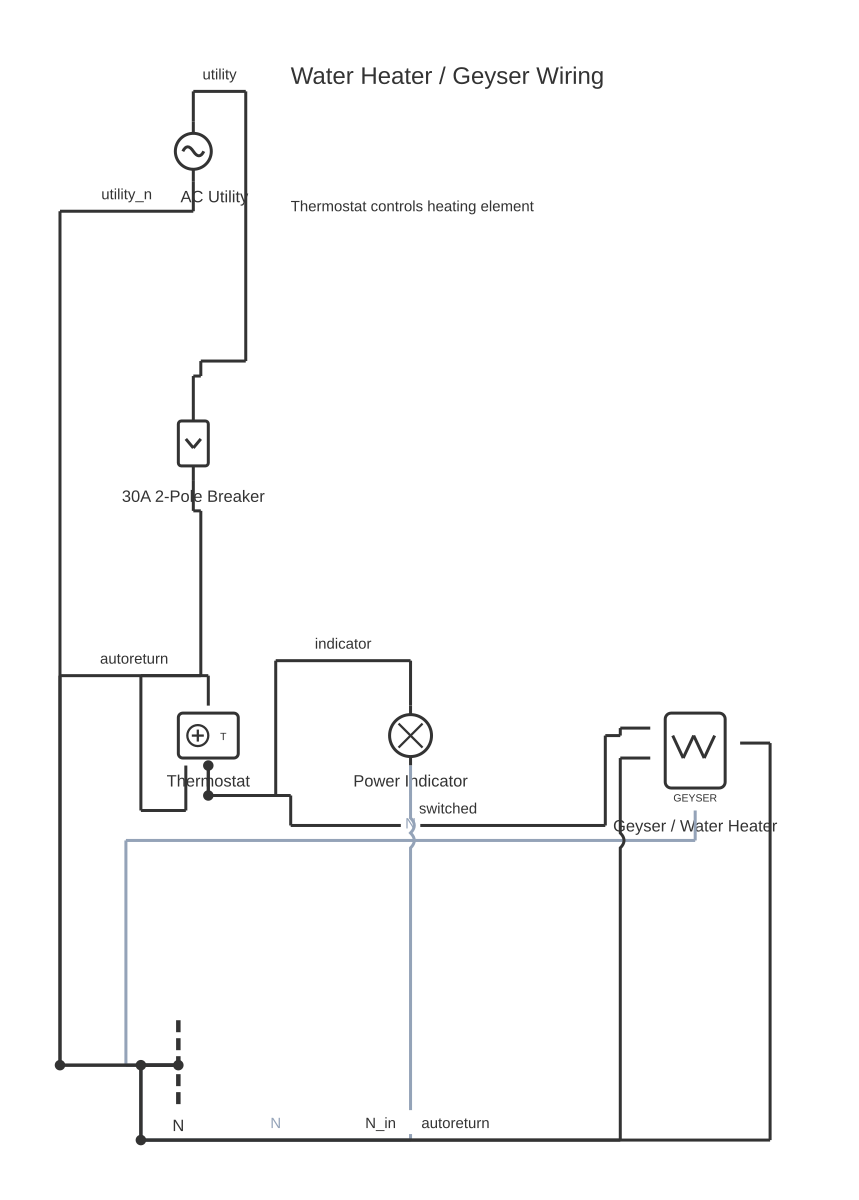
This is a free printable geyser circuit diagram: download the diagram as SVG or open it and print to paper or PDF.
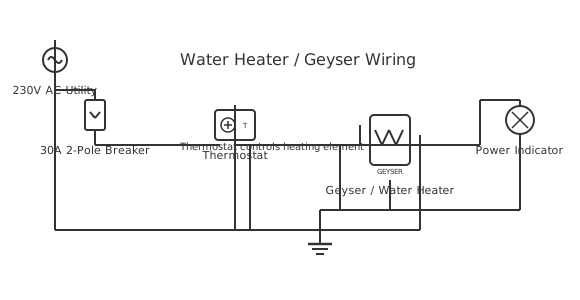
The current drawing contains 6 components and 10 routed connections, including 1 × 30A 2-Pole Breaker (Breaker), 1 × Thermostat (Thermostat), 1 × Geyser / Water Heater (Water Heater), 1 × Power Indicator (Pilot Light) and 1 × N (neutral rail). Use it to inspect the shown topology, then confirm ratings and terminal assignments against the equipment documentation for your installation.
Diagram checks and scope
- Components
- 6
- Wired connections
- 10
- Automated check
- Automated pin, route, source, and topology checks passed; this is not a safety certification.
What this Geyser Circuit Diagram drawing contains. The rendered example uses 1 × 30A 2-Pole Breaker (Breaker), 1 × Thermostat (Thermostat), 1 × Geyser / Water Heater (Water Heater), 1 × Power Indicator (Pilot Light), 1 × N (neutral rail) and 1 × 230V AC Utility (AC voltage source). Lighting drawings must keep the line, switched line, neutral and protective-earth functions unambiguous across every switching point. The component names in the list below come from the editable canvas, while the wire summary comes from the saved start and end terminals. This makes the written explanation auditable against the image instead of presenting an unrelated stock circuit.
Reading the stored graph from terminal to terminal gives this sequence: 1. 30A 2-Pole Breaker load terminal connects to Thermostat rh terminal on the L net. 2. Thermostat w terminal connects to Geyser / Water Heater l terminal on the switched net. 3. Thermostat w terminal connects to Power Indicator pos terminal on the indicator net. 4. Geyser / Water Heater gnd terminal connects to N mid terminal on the N net. 5. Power Indicator neg terminal connects to N mid terminal on the N net. 6. Geyser / Water Heater n terminal connects to N mid terminal on the N_in net. 7. 230V AC Utility pos terminal connects to 30A 2-Pole Breaker line terminal on the utility net. 8. 230V AC Utility neg terminal connects to N mid terminal on the utility_n net. 9. Thermostat c terminal connects to N mid terminal on the autoreturn net. 10. Geyser / Water Heater tstat terminal connects to N mid terminal on the autoreturn net. Its named nets are “L”, “switched”, “indicator”, “N”, “N_in”, “utility”, “utility_n” and “autoreturn”. A line joining two terminals records electrical continuity in this reference; visual proximity alone does not create a connection. Junctions, bridges and terminal labels therefore matter when the drawing is edited or exported.
Trace the live path through protection and the switching contacts to the luminaire, then follow the neutral return independently. Multiway arrangements use common and traveller terminals whose physical positions vary by device. In this particular graph, the first visible path is 30A 2-Pole Breaker load terminal connects to Thermostat rh terminal on the L net., Thermostat w terminal connects to Geyser / Water Heater l terminal on the switched net., Thermostat w terminal connects to Power Indicator pos terminal on the indicator net. and Geyser / Water Heater gnd terminal connects to N mid terminal on the N net.. Follow the remaining rows in the connection table before changing a symbol or moving a conductor, because a neat layout is not evidence that a terminal function is correct.
Confirm the supply system, switch terminal markings, lamp or driver compatibility, neutral availability and earthing requirements. Dimmers and electronic drivers also require an explicit load-type and minimum-load check. Automated validation checks that component IDs and terminal IDs exist, routes terminate on pins, the graph has a recognized source, and the saved topology has no blocking structural fault. It does not determine conductor size, protective-device rating, fault current, insulation class, environmental suitability or compliance with local rules. Those decisions require project values and the current primary documentation.
How to wire geyser circuit diagram
- Read the Geyser Circuit Diagram source path For this geyser circuit diagram, begin at 30A 2-Pole Breaker (Breaker) and trace every stored terminal pair toward the load or output; do not infer continuity from lines that merely cross.
- Match every terminal name Compare the Geyser Circuit Diagram terminal labels shown in the connection table with the current device or standard documentation before assigning real conductors.
- Set project-specific ratings Replace placeholder values in the geyser circuit diagram with verified voltage, current, protection, conductor and environmental data for the actual installation.
- Run the electrical checks again After editing Thermostat (Thermostat) or any route, validate the graph and inspect every reported open terminal, source fault, collision and disconnected island.
- Release a controlled copy Export the revised Geyser Circuit Diagram drawing only after a competent reviewer has compared it with the bill of materials, manufacturer documents and applicable rules.
Specifications
| Topic | Geyser Circuit Diagram |
|---|---|
| Components shown | 6 |
| Routed connections | 10 |
| Named nets | L, switched, indicator, N, N_in, utility, utility_n, autoreturn |
| Verification scope | Stored pins, routes, source path and graph topology |
Safety warnings
- Prove the circuit dead with an appropriate method before touching fixed wiring.
- Keep neutral and protective earth separate except at the bonding point defined by the supply system and local rules.
Tools needed
- The current manufacturer datasheet, connector schedule or applicable standard for every real device
- A suitable meter and proving method for the voltage class being worked on
- The editor validation report and a controlled terminal or wire schedule
Common mistakes
- Treating the geyser circuit diagram illustration as proof of a manufacturer pinout or conductor rating when those values are not encoded in the graph.
- Connecting by component position or wire colour instead of checking the named terminals in the Geyser Circuit Diagram connection path.
- Using terminal position or wire colour to identify common and traveller conductors instead of testing and reading the device markings.
Troubleshooting
- The Geyser Circuit Diagram path appears open
- Cause: A route ends on the wrong pin, a terminal was renamed, or a required return path is absent. Fix: Trace the connection rows in order, restore the documented terminal mapping, and run validation again.
- The edited drawing passes visually but validation fails
- Cause: A conductor may stop off-pin, cross a component body, create a source short or leave a disconnected island. Fix: Open each blocking finding, correct the referenced component or route, then re-run the topology check before export.
- The real equipment behaves differently
- Cause: The stored reference does not match the exact model, revision, supply or contact state. Fix: De-energize safely, return to the current primary documentation, and revise the symbol terminals and values before further testing.
Frequently asked questions
What exactly is verified on this geyser circuit diagram?
The saved Geyser Circuit Diagram graph is checked for known components and terminals, pin-snapped routes, a recognizable source path and blocking topology defects. Exact equipment ratings and manufacturer assignments are outside that automated scope.
Which components are actually shown in this Geyser Circuit Diagram diagram?
The current editable graph contains 1 × 30A 2-Pole Breaker (Breaker), 1 × Thermostat (Thermostat), 1 × Geyser / Water Heater (Water Heater), 1 × Power Indicator (Pilot Light), 1 × N (neutral rail) and 1 × 230V AC Utility (AC voltage source). The bill of materials on this page is derived from those saved symbols rather than a generic shopping list.
How are the geyser circuit diagram connections documented?
The graph contains 10 terminal-to-terminal links. The first path shown is 30A 2-Pole Breaker load terminal connects to Thermostat rh terminal on the L net.
Can I use the drawing as an installation instruction?
Use it as an editable reference and review aid. Verify the exact equipment documentation, ratings, protection, conductor selection and local requirements before construction or release.
Sources and verification
Review status: Not independently reviewed. Automated topology checks confirm stored terminals and routes, not the correctness of manufacturer pin assignments, ratings, regional codes, or installation decisions. Verify those claims against the current primary documentation before use.
- IEC 61082-1:2014 — Rules for electrotechnical documents — International Electrotechnical Commission. Supports: General diagram, drawing, table, and reference-designation presentation conventions. Checked 2026-07-15.
Related diagrams
- 4 to 2 encoder circuit diagram
- 7265 ic circuit diagram
- arduino circuit diagram
- arduino uno circuit diagram
- breadboard circuit diagram
- encoder circuit diagram